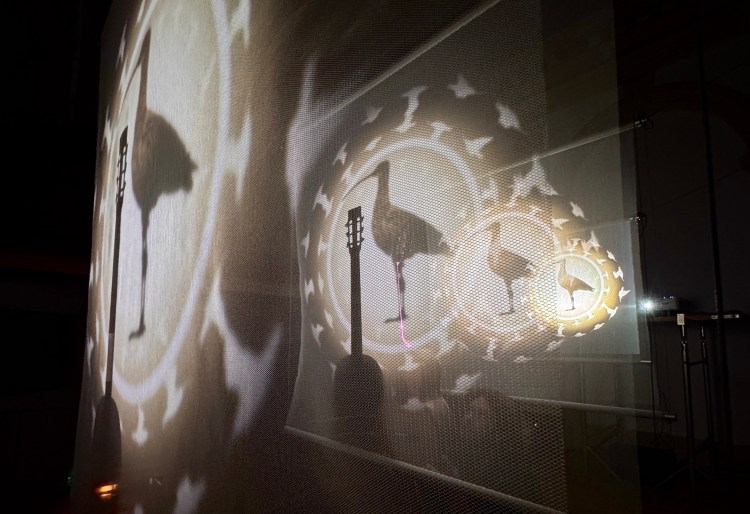
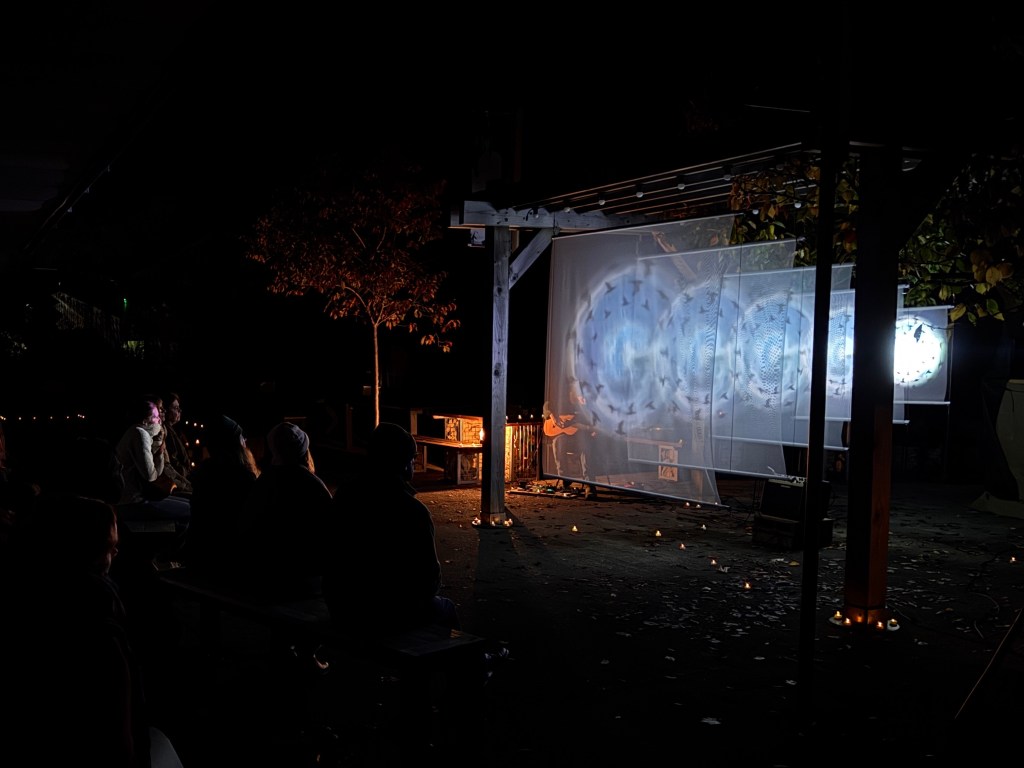
Adar a Ni (Birds and Us) is a performance currently in development. It comprises projected animation and an ephemeral soundworld comprising live guitar playing, looping samples and oral storytelling. The videos shown here collectively give a sense of the work and its evolution and are not intended as marketing content.
Devised and evolved with musician and composer Toby Hay, it is grounded in stories of loss and hope for which birds of resonance and power are vessel. Through them the performance explores our ever-shifting relationship with the more-than-human world. It has a strong ethos of cross-disciplinary partnership working.
Realised in collaboration with Ruthin Craft Centre (The Centre for the Applied Arts Wales), the host venue for a series of test presentations to live audiences, it has been shaped through dialogue with curators and collections at Amgueddfa Cymru (National Museum Wales) and the Centre for Advanced Celtic Studies (National Library of Wales).
The project to date has been funded by the Arts Council of Wales and National Lottery.
Through visiting the past we come to understand the formation of the present, avoid the pitfalls of short-term thinking – and so become better equipped to make the decisions that will enable a survivable future. Forays into past landscapes have been a key component of conversations; both within the development process and as part of test events at Ruthin Craft Centre. In these our guides have been longstanding collaborators historian Professor Mary-Ann Constantine (Centre for Advanced Celtic Studies, Wales), palaeoecologist Professor Danielle Schreve (Heather Corrie Chair in Environmental Change at Bristol University) and archaeologist Dr Elizabeth Walker (Honorary Research Associate, Amgueddfa Cymru).
MOMA Machynlleth generously donated rehearsal space in the form of The Tabernacle Concert Hall, enabling a series of free-to-view rehearsals.
Through their participation in ‘forum’ discussions as part of the performance events at Ruthin Craft Centre, conservation organisations have contributed to the development of the project. These include Rewilding Britain and the Clwydian Range and Dee Valley National Landscape who have brought varied perspectives on nature restoration to this ‘Conference of the Birds’.
The performance aspires to convey birds both in their own umwelten and in ours. Its arc spans contemporary, historic and prehistoric narratives of loss and return, greed and the sacred, interwoven with remembered personal experience and cultural memory. It draws on existing work as a foundation but restructures it for a live, ephemeral dynamic in which the animated birds present the foundation. Every performance is unique, shaped by the unique energy and resonances of that moment and location.
It draws on technologies both analogue and digital. The ‘birds’ are paper cut-outs created using an original printmaking process, itself a deep meditation. These are brought to life through stop-frame animation which acts as intermediary between analogue and digital universes. Computer-based tools amplify the bird’s ‘magic’ and composite them with museum specimens and archival document to create the imagery that illuminates the lantern.
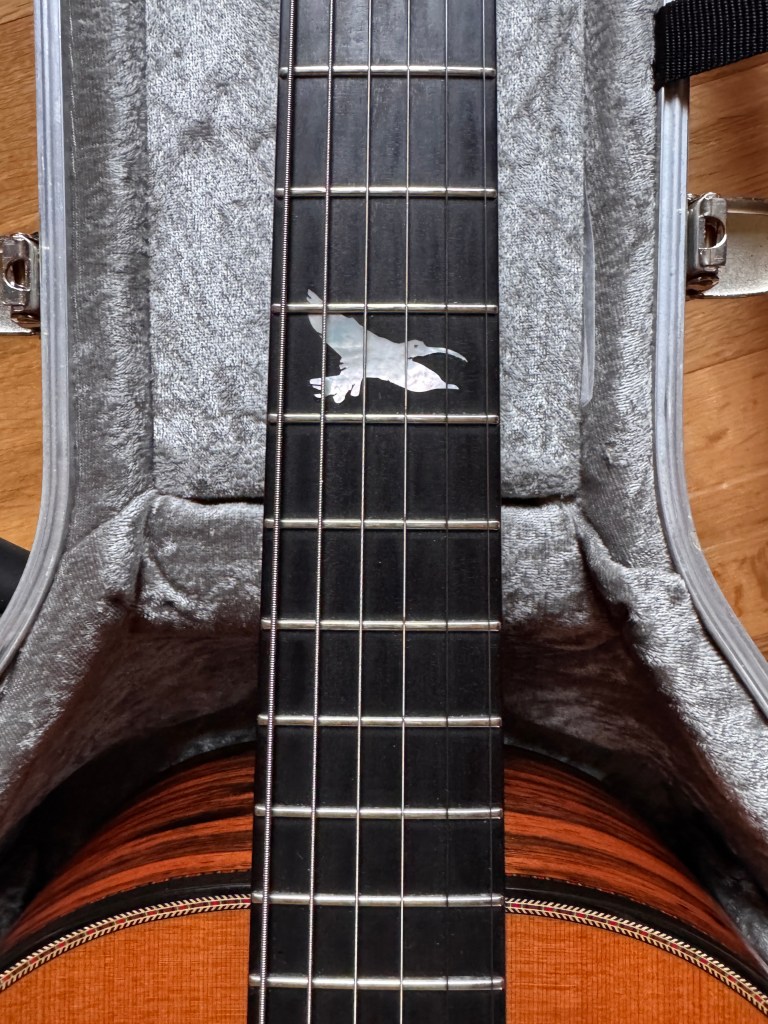
In parallel fashion, Toby Hay plays six and twelve string guitars custom built for him by Roger Bucknall of Fylde Guitars. Intricately plucked notes and lush chord sequences migrate into electronica as part of the performance, combining with ambient field recordings and an archive of bird calls to create sweeping, multi-textured sonic vistas which speak directly to our inner world. It is these internal landscapes which condition our perception of the physical ones we inhabit: in journeying through them we find wonder, deep sorrow and joy; powerful, viscerally-felt agencies for the construction of bridges to the natural world.
Contemporary ‘Western’ science, as a rigorous and effective truth-making system, informs change. But it is emotion which drives and sustains it. Stories populated by birds and relayed in the songs, images, dances and ever-evolving oral traditions of indigenous cultures are, in reality, technologies for the maintenance of cultural and environmental continuity. Whatever the form, these rituals – which we have come to call ‘art’ – transcend fact-based linear logic to resonate within the deep core of our humanity. This is the mechanism which, in creating this performance, we aspire to understand better and thence harness as means to share the feelings of wonder and truth which birds elicit – and thereby engineer what society clunkily refers to as ‘connection to nature’.
In exploring and sharing the stories of birds already familiar to us, we have encountered – and noted – many more through conversations entirely unforeseen along the way…
Our ability to perceive quality in nature begins, as in art, with the pretty. It expands through successive stages of the beautiful to values as yet uncaptured by language. The quality of cranes lies, I think, in this higher gamut, as yet beyond the reach of words.
Aldo Leopold

